Acne scars do not just affect the surface of your skin. They can also affect your confidence, especially when uneven texture or dark marks remain long after acne has cleared. If you are searching for the best treatments for acne scars, you have undoubtedly come across two clinical treatments: face microneedling and chemical peels. But how do you know which one will deliver real, visible transformation for your specific skin type?
Microneedling on the face is best for deep, textured, or indented acne scars (rolling and Boxcar scars) because it stimulates collagen production deep in the dermis. Chemical peels are best for superficial post-acne marks, active breakouts, and post-inflammatory hyperpigmentation (PIH) by exfoliating top skin layers.
Choosing between microneedling and chemical peels comes down to whether your acne scars are structural (indented) or tonal (dark spots). At Evenly Skin & Hair Clinic, our dermatologists tailor the best treatments based on your scar depth and skin tone to ensure safe, effective results. Choosing the wrong procedure can waste your time and money and even worsen post-inflammatory hyperpigmentation if you are not careful.
In this comprehensive guide, we are peeling back the layers on both clinical options. You will learn how mechanical micro-injuries compare to chemical exfoliation, why microneedling with radiofrequency is revolutionizing scar therapy, and how to select the exact medical protocol to achieve clear, radiant, smooth skin.
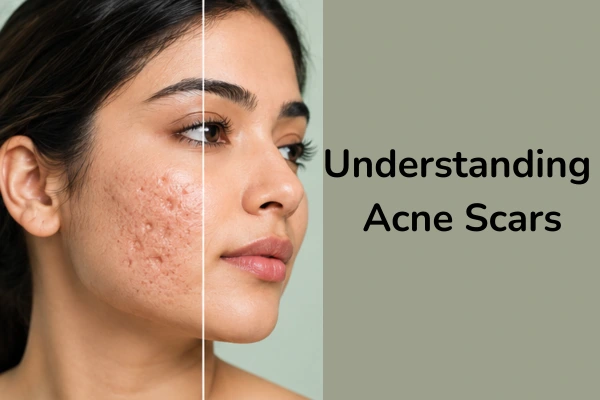
Understanding Acne Scars: Texture vs. Pigmentation
Before selecting the best treatments for acne scars, it is important to understand what you are treating.
Acne can leave behind both structural scars and pigmentation. Some are caused by changes in collagen during the healing process, while others are mainly related to increased pigmentation after inflammation.
Depressed or atrophic acne scars involve a change in the skin’s structure, whereas post-inflammatory hyperpigmentation (PIH) is a flat change in skin color and is not technically a scar.
The Three Main Types of Atrophic Scars
Ice Pick Scars: These are narrow, deep scars that extend vertically into the skin.
Boxcar Scars: These are wider depressions with relatively defined edges.
Rolling Scars: These are broad, shallow depressions that give the skin an uneven or wave-like appearance.
Different scar types respond differently to treatment. Depending on the individual case, a dermatologist may consider microneedling, MNRF, Vampire Facials (microneedling + PRP), chemical peels, subcision, laser resurfacing (fractional CO2), or a combination approach depending on the scar type.
That is why there is no single treatment that can be called the universally best treatment for acne scars.
What is microneedling? A Collagen-Stimulating Treatment
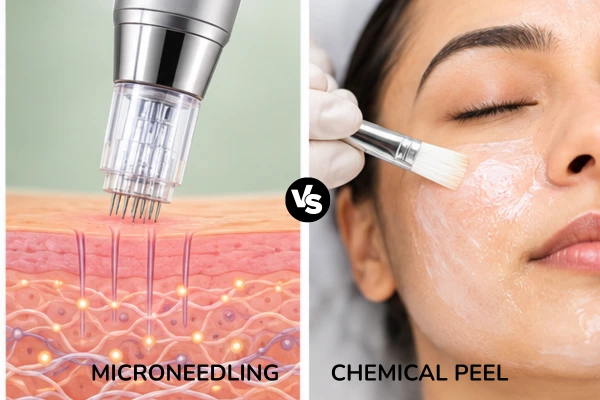
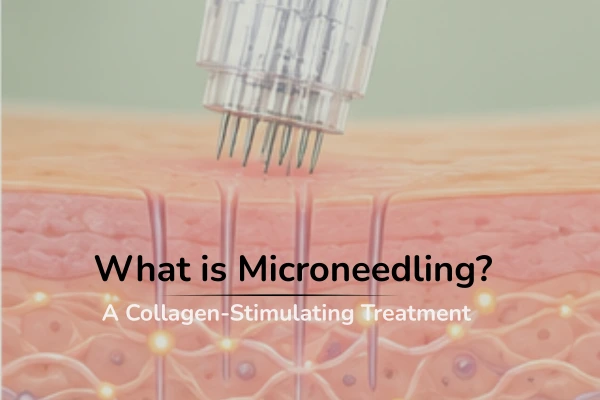
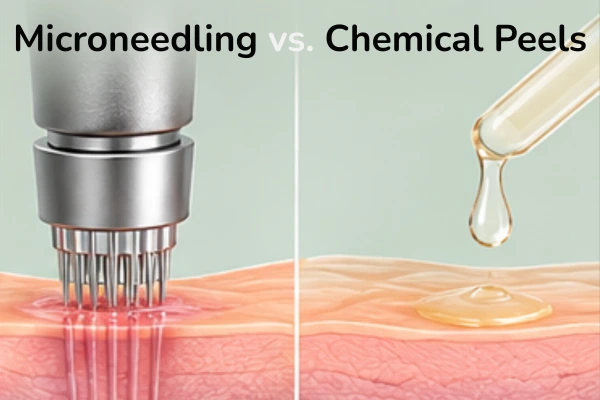
Face microneedling, also called collagen induction therapy, uses a device with fine sterile needles to create controlled micro-injuries in the skin.
These tiny punctures stimulate the body’s natural wound-healing response, encouraging the production and remodeling of collagen and elastin.
The healing process involves several stages:
Inflammation: The body initiates a controlled healing response.
Proliferation: Fibroblasts become active and begin producing new extracellular matrix components, including collagen.
Remodeling: Newly formed collagen gradually reorganizes and strengthens the treated skin.
Over a series of treatments, this process can help improve skin texture and the appearance of certain atrophic acne scars.
Deep ice pick scars and scars with significant fibrous tethering may require other procedures or combination treatments. A dermatologist should determine whether conventional microneedling is appropriate for your particular scar pattern.
Microneedling Before and After: What Should You Expect?
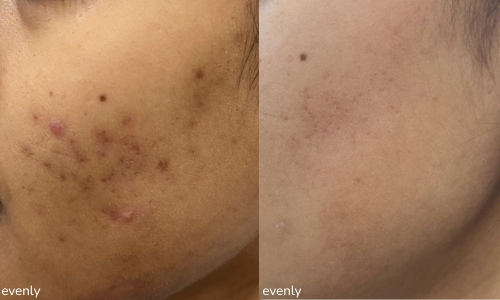
People searching for microneedling before and after results should understand that improvement is gradual.
Microneedling does not instantly fill acne scars. Collagen remodeling takes time, and visible improvement usually develops progressively over several weeks and treatment sessions.
Results can vary depending on:
Scar type and depth
Number of treatments
Skin type
Age of the scars
Individual healing response
The effectiveness of microneedling may vary depending on whether it is combined with another treatment.
The needles deliver RF energy at selected depths, creating controlled thermal stimulation within the skin. This can encourage collagen remodeling and may also help with certain textural concerns and mild skin laxity.
RF microneedling may be considered for certain types of:
Atrophic acne scars
Uneven skin texture
Enlarged pores
Mild skin laxity
However, RF microneedling is not automatically better than conventional microneedling for every acne scar. The appropriate technology, needle depth, energy settings, and treatment plan should be selected by a qualified dermatologist based on the patient’s skin and scar characteristics.
What Are Chemical Peels for Acne Scars?
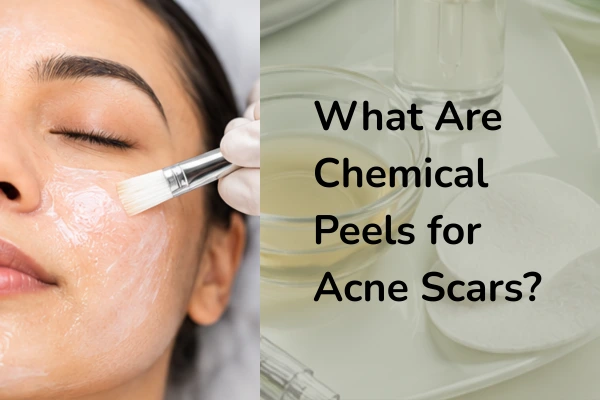
Chemical peels use professionally selected chemical solutions to produce controlled exfoliation of the skin and encourage skin renewal.
Depending on the peeling agent, concentration, and treatment technique, chemical peels may help improve:
Post-inflammatory hyperpigmentation
Uneven skin tone
Mild acne
Surface roughness
Dullness
Certain superficial acne marks
Common peeling agents include salicylic acid, glycolic acid, lactic acid, and trichloroacetic acid (TCA). The choice of peel should be based on your skin condition rather than simply choosing the strongest peel available.
Which Chemical Peel Is Suitable for Acne-Prone Skin?
Different chemical peels have different properties and uses.
Salicylic acid peels: Often considered for acne-prone and oily skin because salicylic acid is oil-soluble and can work within clogged pores.
Glycolic acid peels: May help with superficial pigmentation, uneven skin tone, and some textural concerns.
Lactic acid peels: Generally provide a gentler exfoliating approach and may be considered for selected pigmentation and texture concerns.
TCA: TCA can be used in different concentrations and techniques for specific dermatological concerns.
Microneedling vs. Chemical Peels: Quick Comparison
To help you decide, here is how both clinical options compare across critical parameters:
Feature
Microneedling (Collagen Induction)
Chemical Peels (Skin Exfoliation)
Primary Target
Collagen remodeling, atrophic scars and texture
Pigmentation, acne and superficial skin texture
Skin Layer Treated
Deep Dermis (triggers repair from within)
Surface Epidermis to upper Dermis
Best Scar Types
Rolling, Boxcar, and Atrophic Scars
Post-Acne Hyperpigmentation (PIH) & Ice Pick
Typical Downtime
1–3 Days (mild redness, like a sunburn)
3–7 Days (flaking and peeling skin)
Safety for All Skin Types
Exceptionally high safety for darker skin tones
Requires carefully chosen dermatological acids
Action Depth
Deep dermis (0.5mm to 2.5mm)
Epidermis to upper papillary dermis
Sessions Required
3 to 6 sessions (spaced 4 weeks a part)
3 to 6 sessions (spaced 2-4 weeks a part)
Important: Treatment depth, number of sessions, and downtime vary significantly depending on the device, peel formulation, concentration, skin type, and individual treatment plan.
How Microneedling Works for Acne Scars
Microneedling creates controlled micro-injuries in the skin using sterile, fine needles. This activates the skin’s natural healing response and stimulates collagen remodeling.
Microneedling May Be Recommended For:
Pitted acne scars
Rolling scars
Selected boxcar scars
Uneven skin texture
Enlarged pores associated with textural concerns
Key Benefit
Microneedling works primarily by stimulating collagen remodeling rather than removing the outer layers of skin. However, people with darker skin tones can still develop post-inflammatory hyperpigmentation after procedures, so treatment settings and aftercare need to be individualized.
Chemical peels are recommended for treating acne marks.
Chemical peels apply a professionally selected solution to the skin, producing controlled exfoliation and stimulating skin renewal.
Chemical Peels May Be Recommended For:
Post-inflammatory hyperpigmentation
Dark acne marks
Active acne
Uneven skin tone
Superficial textural concerns
Key Advantage
Certain chemical peels can address acne and pigmentation at the same time, making them useful when active breakouts and post-acne marks occur together.
However, chemical peels generally cannot restore significant collagen volume lost in deep atrophic acne scars.
Microneedling vs. Chemical Peel: Which Treatment Do You Need?
Instead of asking which treatment is universally better, start by identifying your primary concern.
Microneedling May Be Considered If:
Your main concern is depressed or uneven acne scars.
You have rolling scars or selected boxcar scars.
You want to stimulate collagen remodeling.
Your primary concern is skin texture rather than only pigmentation.
Chemical Peels May Be Considered If:
Your main concern is flat, dark acne marks or PIH.
You have active acne along with post-acne pigmentation.
You want to improve superficial uneven skin tone.
Your dermatologist determines that a particular peel is appropriate for your skin.
What If You Have Both Acne Scars and Pigmentation?
You may not have to choose just one treatment.
Many people have a combination of:
Depressed acne scars
Dark post-acne marks
Enlarged pores
Uneven skin texture
Active acne
In these cases, a dermatologist may recommend a customized combination treatment plan.
Can You Combine Microneedling and Chemical Peels?
Yes, microneedling and chemical peels may sometimes be used as part of a combination acne-scar treatment plan.
However, they should not automatically be performed together or one immediately after another.
A dermatologist may schedule different procedures at appropriate intervals depending on:
Your skin type
Scar severity
Pigmentation tendency
Active acne
Previous treatments
Healing response
Your dermatologist can determine whether combining treatments is appropriate and how much time should be allowed between procedures.
When choosing between microneedling and chemical peels for acne scars, the first step is to identify what you are actually treating.
Microneedling focuses on collagen remodeling and may be useful for selected depressed acne scars and uneven texture.
Chemical peels primarily work through controlled exfoliation and skin renewal and may be useful for pigmentation, active acne, and superficial skin concerns.
If acne scars or post-acne marks are bothering you, consult a dermatologist to understand which treatment is appropriate for your skin before starting a procedure.
Evenly Skin and Hair Clinic – HSR Layout
Third Floor, 815, 27th Main Rd, above Bluestone, 1st Sector, HSR Layout, Bengaluru, Karnataka 560102
Evenly Skin and Hair Clinic – Jayanagar
35, Ground Floor, Vinyas Arcade, 11th Main Rd, Vishya Bank Colony, 5th Block, Jayanagar, Bengaluru, Karnataka 560041
Third floor, Embassy Tower, 9/1/3, Mahatma Gandhi Rd, Near Treasure Island, South Tukoganj, Indore, Madhya Pradesh 452001
For health-related information, follow us on Instagram!!
Frequently Asked Questions
How many microneedling sessions are needed for acne scars?
The number of sessions varies depending on scar type and severity. A series of treatments is often recommended, with sessions commonly spaced several weeks apart to allow the skin to heal and remodel.
How many chemical peels are needed for acne marks?
The number of chemical peel sessions depends on the type of peel, pigmentation severity, acne activity, and your skin’s response.
Are chemical peels painful?
Depending on the type and strength of the peel, you may experience temporary tingling, warmth, or mild stinging. Deeper or stronger peels may involve more discomfort and downtime.
Can microneedling remove acne scars permanently?
Microneedling cannot completely erase every acne scar. It can gradually improve the appearance of selected atrophic scars through collagen remodeling. The extent of improvement depends on the type and severity of the scars, treatment plan, and individual response.
Where can I get customized acne scar treatment in Bangalore?
A dermatologist should evaluate your acne scars before selecting a procedure. Evenly Skin & Hair Clinic provides customized skin and acne-scar treatment plans at its clinics in HSR Layout, Indiranagar, Jayanagar, and Indore.
We hope this information is helpful. If you have any skin and hair-related questions or would like to discuss personalized solutions, please reach out to us at 7337899030. Our team of specialists is committed to delivering personalized care tailored to your specific needs. Take the first step towards a healthier, more confident you by scheduling a consultation with us today. Your journey to vibrant skin and stronger hair begins here.
Post Views:123
Book an Appointment
Start your journey to healthy skin and hair today.







Leave a Comment