Have you noticed more hair on your pillow lately? Or perhaps your once thick ponytail feels thinner, lifeless, and harder to manage? If you are dealing with unexplained shedding, it can feel confusing and frustrating. You are eating well. You are using quality hair products. You even switched shampoos. Yet the hair fall continues. Naturally, one worrying question begins to surface—can thyroid cause hair fall?
Many people in Bangalore’s fast-paced work culture blame stress, hard water, or pollution for excessive shedding. While these factors can contribute, what most people do not realize is that a silent hormonal imbalance may be disrupting the hair growth cycle from within. In fact, hair fall due to thyroid imbalance is one of the most underestimated medical causes of persistent hair thinning, especially among women.
Unlike temporary shedding, a hair fall thyroid problem does not improve with oils, supplements, or random treatments. It continues quietly because the root cause lies in hormone regulation rather than external damage.
The answer is yes. Thyroid-related hair loss is both common and treatable when diagnosed correctly. At Evenly Clinic in Bangalore, many patients initially assume stress or pollution is solely responsible for their thinning hair. But, after proper evaluation, we often identify an underlying thyroid imbalance affecting the hair growth cycle.
In this detailed guide, our dermatology team will break down the science behind thyroid-related hair loss, explain the symptoms and diagnosis process, and discuss the most effective thyroid hair loss treatment options available today, so you can finally understand what your hair is trying to tell you.
The thyroid gland, located in the front of your neck, regulates metabolism, cellular turnover, oxygen utilization, and protein synthesis. Because hair follicles are among the most metabolically active cells in the body, they are highly sensitive to hormonal shifts.
When thyroid hormones (T3 and T4) fluctuate, either decreasing (hypothyroidism) or increasing (hyperthyroidism), hair follicles shift prematurely from the growth phase (anagen) into the resting phase (telogen). As a result, hair fall due to thyroid disease begins gradually but progressively.
What Causes Hair Thinning in Hypothyroidism?
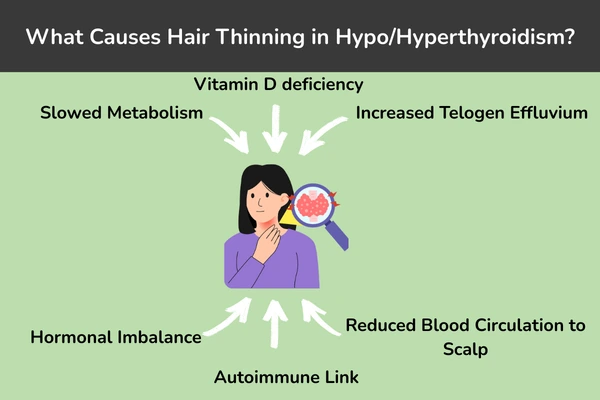
Let us address this directly: What causes hair thinning in hypothyroidism? It is not just a “hormone imbalance.” The mechanism is more layered.
Hypothyroidism slows down the body’s metabolic functions. Consequently, hair follicles receive reduced stimulation and slower protein synthesis. Over time, this results in:
Additionally, decreased thyroid hormone reduces keratin production. Since keratin forms the structural foundation of hair, its deficiency leads to brittle strands that break easily.
Each of these further worsens hair fall due to thyroid disease.
How Hair Fall Due to Thyroid Differs from Normal Hair Shedding
Not all hair fall is equal. Therefore, identifying patterns helps.
Normal Hair Fall
Hair Fall and Thyroid Disease
Seasonal
Persistent
Improves with care
Does not improve with oils
No systemic symptoms
Fatigue, weight changes, cold sensitivity
Temporary
Chronic until treated
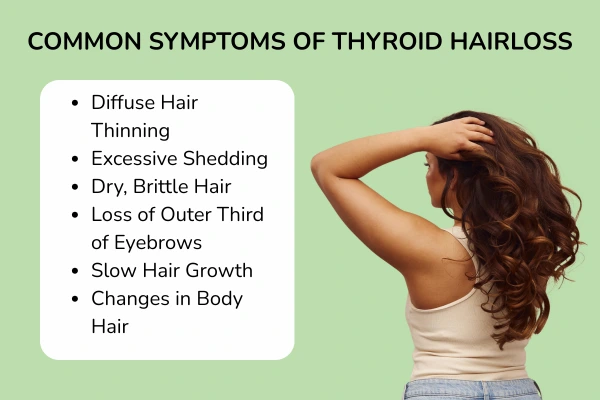
Moreover, patients often notice eyebrow thinning, which strongly indicates hypothyroidism.
If you are experiencing these signs, it may not be “just stress.”
Hyperthyroidism vs. Hypothyroidism: Do Both Cause Hair Loss?
Yes—both can.
Although hypothyroidism is more commonly linked to hair fall due to the thyroid, hyperthyroidism can also disrupt hair cycling.
In hyperthyroidism:
Metabolism accelerates excessively.
Hair cycle shortens
Diffuse thinning occurs
However, the texture may feel fine and silky rather than coarse and dry.
Therefore, proper thyroid profiling is essential before starting any thyroid hair loss treatment.
Can Thyroid Cause Hair Fall Even After Medication?
This is a frequent concern. Even when patients begin thyroid medication, hair fall may persist temporarily. Why?
Because hair cycles take 3–6 months to stabilize. Additionally, improper dosage adjustment may continue to affect follicular activity.
Therefore, thyroid correction alone may not immediately reverse hair fall due to thyroid disease; a combined dermatological approach works better.
Why Bangalore Lifestyle Can Worsen Thyroid Hair Loss
Living in Bangalore comes with unique stressors:
Long hours in air-conditioned offices
High work stress in tech sectors
Pollution exposure during commute
Vitamin D deficiency due to indoor lifestyle
When these factors combine with thyroid imbalance, they amplify hair fall and thyroid problem severity.
Thus, patients often experience accelerated thinning unless both hormonal and environmental triggers are addressed.
The Science Behind Thyroid Hair Loss
To understand this better, let us briefly look at follicular biology.
The hair growth cycle includes
Anagen (Growth Phase)
Catagen (Transition Phase)
Telogen (Resting Phase)
Exogen (Shedding Phase)
In hypothyroidism, follicles prematurely enter the telogen phase. Consequently, more strands shed simultaneously, a condition known as chronic telogen effluvium secondary to thyroid dysfunction.
Thyroid Hair Loss Treatment: What Actually Works?
Treating hair fall due to thyroid disease requires dual action: hormonal and dermatological.
Phase 1: Hormonal Stabilization
First and foremost, thyroid hormone levels must normalize. Without this step, no cosmetic treatment will give long-term results.
Endocrinologist-guided medication normalizes TSH levels. However, dosage adjustment must be monitored every 6–8 weeks.
Phase 2: Correcting Associated Deficiencies
At Evenly Clinic, we address deficiencies aggressively by recommending iron supplementation, vitamin D, B12, and zinc correction. Unless these are corrected, hair fall due to thyroid continues despite medication.
Effective Hair Regrowth Treatments for Thyroid Imbalance
Once thyroid hormone levels are medically stabilized, advanced hair regrowth treatments help reactivate weakened follicles and accelerate visible improvement. These procedures are especially beneficial in cases of persistent hair fall due to thyroid disease, where follicles remain in a prolonged resting phase.
PRP (Platelet-Rich Plasma Therapy)
PRP uses the patient’s own blood to extract concentrated growth factors, which are then injected into thinning areas of the scalp. These growth factors stimulate dermal papilla cells, improve scalp circulation, and help shift follicles back into the active growth (anagen) phase.
For patients with a hair fall thyroid problem, PRP reduces shedding, improves hair thickness, and gradually enhances overall density when combined with proper hormonal management.
GFC (Growth Factor Concentrate)
GFC is an advanced regenerative treatment that delivers a highly purified concentration of growth factors directly into the scalp. It promotes follicular stem cell activation, strengthens weakened follicles, and supports a longer growth phase.
In cases of hair thinning in hypothyroidism, GFC helps improve follicular strength and encourages healthier, thicker regrowth when used alongside thyroid correction.
How Long Does Regrowth Take?
Most patients begin noticing:
Reduced shedding within 8–12 weeks
Visible baby hair growth by 3–4 months
Improved density by 6 months
However, consistency matters because hair fall from thyroid disease is hormonal; sudden discontinuation of medication may reverse progress.
Can Thyroid Hair Loss Become Permanent?
Generally, no—if treated early.
If untreated for years, prolonged hormonal imbalance may miniaturize follicles. However, in the majority of cases, hair fall due to thyroid is reversible with timely medical intervention.
Therefore, early evaluation prevents chronic thinning.
Lifestyle Factors That Accelerate Thyroid Hair Fall
Even after medication, certain triggers worsen shedding:
Diet Strategies That Support Thyroid Hair Recovery
Although diet alone cannot cure a hair fall thyroid problem, it supports regrowth.
Include:
Selenium-rich foods (Brazil nuts)
Omega-3 fatty acids
Lean protein
Iodine in controlled amounts
Anti-inflammatory foods
Avoid excessive soy and processed foods.
When Should You See a Dermatologist?
Consult a specialist if:
Hair fall persists beyond 3 months.
You notice widening of the hair part.
Eyebrow thinning occurs
Thyroid levels fluctuate repeatedly.
Early intervention prevents chronic follicular damage.
So, can thyroid cause hair fall? Absolutely yes!
Hair fall due to thyroid disease is manageable and often reversible with the right combination of medical and regenerative treatments.
If you are struggling with a persistent hair fall thyroid problem, do not rely solely on home remedies. Instead, opt for a structured thyroid hair loss treatment plan guided by medical experts.
At Evenly Clinic, Bangalore, our dermatologists evaluate the hormonal profile, nutritional deficiencies, scalp health, and lifestyle triggers before recommending effective hair regrowth treatments for thyroid imbalance.
Evenly Skin and Hair Clinic – HSR Layout
Third Floor, 815, 27th Main Rd, above Bluestone, 1st Sector, HSR Layout, Bengaluru, Karnataka 560102
Evenly Skin and Hair Clinic – Jayanagar
35, Ground Floor, Vinyas Arcade, 11th Main Rd, Vishya Bank Colony, 5th Block, Jayanagar, Bengaluru, Karnataka 560041
Yes, thyroid imbalance can cause hair fall. Both hypothyroidism and hyperthyroidism disrupt the hair growth cycle, pushing more hair follicles into the resting phase. As a result, excessive shedding and diffuse thinning occur.
What causes hair thinning in hypothyroidism?
Hair thinning in hypothyroidism occurs because low thyroid hormone slows cellular turnover, reduces keratin production, and decreases blood flow to hair follicles.
How do I know if my hair fall is due to thyroid disease?
Hair loss from thyroid disease usually presents with additional symptoms such as fatigue, weight gain, cold intolerance, dry skin, irregular menstrual cycles, and eyebrow thinning.
Can thyroid medication cause hair loss?
Temporary hair shedding may occur when starting or adjusting thyroid medication, especially if hormone levels fluctuate. However, this is usually short-term. Proper dosage stabilization reduces shedding over time.
Are PRP and GFC effective for hair fall due to thyroid?
Yes, PRP and GFC are effective hair regrowth treatments for thyroid imbalance when hormone levels are controlled. These therapies stimulate dormant follicles, improve scalp circulation, and enhance hair density.
Does hyperthyroidism also cause hair loss?
Yes, hyperthyroidism can cause hair thinning by accelerating metabolism and shortening the hair growth cycle. Unlike hypothyroidism, hair texture may feel fine and silky rather than coarse and dry.
We hope this information is helpful. If you have any skin and hair-related questions or would like to discuss personalized solutions, please reach out to us at 7337899030. Our team of specialists is committed to delivering personalized care tailored to your specific needs. Take the first step towards a healthier, more confident you by scheduling a consultation with us today. Your journey to vibrant skin and stronger hair begins here.
Post Views:694
Book an Appointment
Start your journey to healthy skin and hair today.







Leave a Comment