Chickenpox is a common viral infection that most people experience at least once in their lifetime. While the fever, rashes, and blisters usually settle within a week, the marks they leave behind often linger much longer. These stubborn chickenpox mark, especially the deep pits that appear on the face, can take months or even years to fade on their own.
If you are the one who is searching for why chickenpox leaves scars and how to get rid of them effectively, this blog is for you. Whether they are fresh or years old, chicken pox scars or mark are completely treatable with the advanced dermatological treatments. This comprehensive guide will help you understand why chickenpox scars form and the most effective options to treat deep pox mark or scars safely and quickly, restoring healthy and clear skin.
Can Chicken Pox Leave Scars: How and Why Does It Happen?
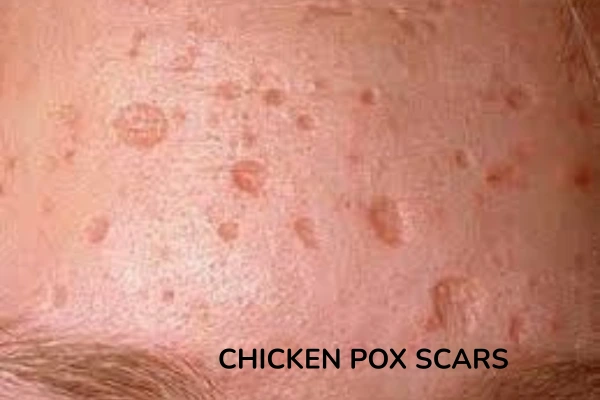
Most people recover from chickenpox without any scars. However, some experience deep marks, pits, or dark spots. This difference mainly depends on how deeply the skin was affected.
Deep Dermal Damage: Chickenpox blisters inflame the deeper dermis. When inflammation reaches this level:
Collagen starts to break down and deteriorates
When collagen weakens, it leads to the collapse of the supporting tissue.
This results in pitted chickenpox scars, the most common type found on the face.
Scratching or Picking the Lesions: Chickenpox causes intense itching. When a person scratches, the blister bursts, the skin tears,and deeper layers get injured. This increases the chance of permanent pox marks on the face, often visible as small pits or craters.
Secondary Infection: If bacteria enter the lesion, the inflammation deepens. More inflammation will give more damage leading to more visible scarring.
This is why people who scratched aggressively or had infected blisters developed deeper chickenpox scars.
Improper Healing: After the blister dries, some people heal with excess pigment (brown spots), some develop redness, and some produce insufficient collagen, forming sunken pits. This explains why chickenpox scars vary from person to person.
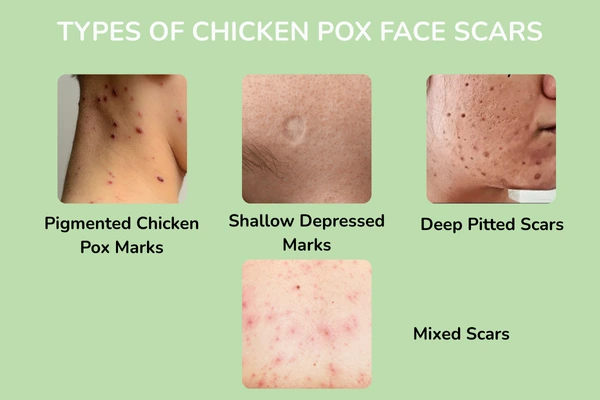
Types of chickenpox face scars: Identify Your Scar
Understanding which mark or scar type you have is the first step in choosing the right treatment for chickenpox scars.
Pigmented Chickenpox Mark/Scars
These are brown or reddish spots that appear after the blister heals. They are not actual scars, and they will respond well to advanced treatments like chemical peels, laser toning, and topical brightening agents.
Shallow Depressed Marks
These appear like small, soft dents. These marks respond well to microneedling, microneedling radiofrequency, and laser resurfacing (fractional CO₂ laser).
Deep Pitted Scars (Chickenpox Holes)
These are the most stubborn and resemble acne ice-pick scars. The best treatmentsfor these types of scars include CO₂ fractional laser, TCA cross peel, MNRF, and hyaluronic acid fillers (for severe pits).
Mixed Scars
Many people have a combination of pigmentation and pits. This requires a multi-step treatment plan for best results.
Can Chickenpox Scars Go Away Naturally? The Honest Truth
Many blogs give a list of home remedies to remove chickenpox scars, but as per the dermatologist, deep chickenpox pits cannot disappear naturally or with home remedies. Here is what can naturally improve pigmentation, redness, and mild dents.
However, here’s what cannot improve naturally: deep pitted scars, old chickenpox holes, and atrophic scars. These require collagen stimulation, which only dermatological treatments can treat effectively.
Home Remedies: What Works and What Doesn’t
People often try remedies like aloe vera, coconut oil, lemon juice, turmeric, or vitamin E. Let’s look at what they can and cannot do.
What Home Remedies Can Help With
Mild pigmentation
Improving moisture
Reducing inflammation
Soothing the skin
They support healing but cannot rebuild collagen.
What Home Remedies Cannot Do
Fill deep pits
Tighten collagen
Remodel damaged tissue
Remove chickenpox holes on face
So while natural methods may slightly improve skin tone, they cannot treat pitted chickenpox scars.
How to Get Rid of Chicken Pox Mark: Dermatologist-Approved Treatments
There are many advanced treatments available for chicken pox mark, but it is difficult to recommend the right one without knowing the severity. To know the type, depth, age, and severity of the pox marks, it is always advisable to meet a dermatologist; they will suggest the right treatment. Here is a list of treatments offered by the Evenly clinic for chicken pox scars.
Fractional CO2 Laser (Laser Resurfacing)
This laser resurfacing treatment is one of the most recommended treatments for chicken pox marks. During this procedure, controlled laser energy is delivered directly onto the scarred skin. The heat from the laser gently removes damaged tissue while stimulating new collagen formation underneath. A trained dermatologist adjusts the intensity and depth of the laser to ensure precision and protect the surrounding healthy skin. Over a series of sessions, the laser smoothens the sunken areas, reduces the depth of pitted chickenpox scars, and lightens any discoloration associated with old marks.
Most patients require 6-8 sessions, depending on the number and severity of scars. The procedure is minimally invasive, involves little to no downtime, and offers noticeable improvement in both texture and appearance.
Best for: Deep pitted scars, Chickenpox holes, atrophic pits
Chemical peels for chickenpox marks work by exfoliating the top layers of damaged skin using medically formulated peeling agents. Dermatologists typically use alpha hydroxy acids (AHAs), beta hydroxy acids (BHAs), or medium-depth agents like TCA to target deeper pigmented or pitted marks.
Once applied, the peel accelerates cell turnover and boosts collagen production, helping the skin gradually become smoother and more even-toned. Chemical peels are especially effective for improving superficial pox marks, pigmentation, and mild textural irregularities.
Depending on the skin type and scar depth, 6-8 sessions may be recommended. This treatment has minimal downtime, making it a quick and convenient option for many patients.
Microneedling Radiofrequency (MNRF) is a highly effective option for deeper, indented chickenpox mark or scars on the face. The procedure uses fine, insulated needles to deliver radiofrequency energy into the deeper layers of the skin. This thermal energy triggers an intense collagen remodeling response, gradually lifting and filling the depressed scars.
Unlike basic microneedling, MNRF works at a deeper level, improving stubborn pitted scars that do not respond to topical treatments or superficial procedures. Most patients require 4-6 sessions, with mild downtime lasting 24–48 hours. Over time, the skin becomes firmer, smoother, and more uniform.
Dermal Fillers
Dermal fillers are an excellent option for chickenpox scars that appear deeply sunken or volume-deficient. Hyaluronic acid-based fillers are injected into the depressed scars to raise the surface and instantly create a smoother texture.
While fillers offer immediate improvement, their best results occur when used alongside treatments like laser resurfacing, which help address the root cause of the scar. Results typically last 6–12 months, and the procedure has no downtime.
Microdermabrasion
Microdermabrasion is a mild, non-invasive treatment that exfoliates the outermost damaged skin layer using a specialized abrasive applicator. Although not suitable for very deep chickenpox mark, it plays an effective role in improving superficial scars, pigmentation, and uneven texture.
The gentle resurfacing encourages new skin cell growth, giving the skin a smoother and brighter appearance. Patients usually return to regular activities immediately, as downtime is minimal.
How many sessions are needed to remove pitted scars?
The number of sessions needed depends on the depth of the scar, the number of pits you have, the age of the scars, the skin type, and the treatment chosen.
In general, mild marks may take 2-4 sessions to get rid of, moderate pits may take 4-6 sessions, and deep or old scars require 6-8 sessions.
Results improve continuously as collagen remodels for 3–6 months.
Post-care instructions to prevent darkening or worsening
After any chicken pox scars treatment, it is recommended to:
Stay out of the sun as much as possible.
Apply sunscreen consistently.
Do not scratch, pick, or irritate the skin.
Maintain proper moisture with a gentle moisturizer.
Follow your dermatologist’s instructions carefully.
Avoid using rough scrubs on the treated area.
Following proper post-care instructions accelerates healing and prevents pigmentation.
Why Treat Chickenpox Face Scars Early?
Old scars can also be treated with the advanced solutions, but fresh scars respond faster as:
Collagen response is better
Pigmentation is lighter.
Tissue stiffness is lower
Early intervention = Fewer sessions + Better results.
Chickenpox Mark Treatment Cost in Bangalore
The cost totally depends on the treatment type:
S.No
Chicken Pox Scars Treatment
Price Range per session
1
Chemical Peels
Rs. 3000 to Rs. 10000
2
Laser Resurfacing
Rs. 5500 to Rs. 12000
3
Microdermabrasion
Rs. 3000 to Rs. 6000
4
Microneedling
Rs. 5000 to Rs. 8500
5
MNRF (Microneedling & Radiofrequency)
Rs. 10000 to Rs. 15000
6
Dermal Fillers
Based on the units recommended
Note: The below-mentioned prices are not the actual prices of Evenly Skin and Hair Clinic; they may vary based on your skin type, depth, technology used, and tone. To know the actual price, please consult a dermatologist.
At Evenly Clinic, treatments are customized and explained with complete transparency.
How to prevent the chickenpox scars on the face?
Chicken pox cannot be avoided, but sometimes the scars can be prevented by following these tips:
Avoid scratching
Clean the affected area without fail.
Trim your nails during infections.
Use calamine lotion to soothe the skin.
Maintain proper hydration with a good moisturiser.
Chickenpox marks, whether they are pits, holes, or dark spots, do not have to be permanent. With modern dermatological treatments, our expert dermatologists can restore your skin’s texture, boost collagen, and reduce those stubborn scars significantly. We have treated hundreds of patients with chickenpox marks. Our dermatologists specialize in scar revision, especially pitted chickenpox scars, using advanced US-FDA-approved technologies.
What makes our approach different?
Customized treatment based on scar depth
Focus on collagen remodeling for long-term results
Minimal downtime protocols
Combinational treatment for improvement
Results-driven patient follow-up
And if you are ready to treat your chickenpox marks safely and effectively, the dermatologists at Evenly Skin and Hair Clinic are here to help you transform your skin with science-backed solutions.
Evenly Skin and Hair Clinic – HSR Layout
Third Floor, 815, 27th Main Rd, above Bluestone, 1st Sector, HSR Layout, Bengaluru, Karnataka 560102
Evenly Skin and Hair Clinic – Jayanagar
35, Ground Floor, Vinyas Arcade, 11th Main Rd, Vishya Bank Colony, 5th Block, Jayanagar, Bengaluru, Karnataka 560041
Mild and shallow chickenpox marks may fade over a few months, but deeper pitted scars rarely disappear without treatment.
Why do chickenpox scars happen?
Chickenpox blisters damage the upper and lower layers of skin. If the blister is scratched or infected, it destroys collagen, leaving behind depressed (pitted) holes or dark marks.
How to Remove Deep Chicken Pox Scars Naturally?
Removing deep chicken pox scars naturally is not possible. It just simply improves the skin texture slightly but cannot rebuild lost collagen or fill pitted scars.
Is laser treatment safe for chickenpox scars?
Yes, when done by an experienced dermatologist. Modern lasers precisely target scar tissue without damaging surrounding skin. Mild redness is normal and subsides in a day or two.
Can chickenpox scars be removed from the face completely?
Completely erasing deep pitted scars is difficult, but treatments can reduce their visibility by 60–80%, depending on the severity.
Can I undergo treatment if my chickenpox is recent?
No. Treatment should begin only after the blisters are fully healed and the skin has recovered, usually after 6–8 weeks.
Can chickenpox scars get worse over time?
The appearance may seem more prominent as skin loses collagen with age. Early treatment can prevent scars from looking deeper later.
We hope this information is helpful. If you have any skin and hair-related questions or would like to discuss personalized solutions, please reach out to us at 7337899030. Our team of specialists is committed to delivering personalized care tailored to your specific needs. Take the first step towards a healthier, more confident you by scheduling a consultation with us today. Your journey to vibrant skin and stronger hair begins here.
Post Views:4,029
Book an Appointment
Start your journey to healthy skin and hair today.










Leave a Comment