White spots on face are often mistaken as a minor cosmetic issue, but in clinical dermatology, they are rarely superficial. For many patients, white marks on face raise persistent concerns. Why is my skin losing color? Is it permanent? Will it spread?These questions are valid, because these spots on face are usually a visible signal that the skin’s natural pigment system is disturbed.
From a dermatologist’s perspective, white spots on face occur when melanin production, transfer, or survival is reduced in certain areas. Melanin is produced by specialized cells called melanocytes, and when these cells become inactive, damaged, or destroyed, white marks on face begin to appear. These spots may vary in size, texture, and progression. While some white spots are temporary and harmless, others require early medical attention to prevent progression.
What makes white spots on face particularly challenging is that there is no single cause and no single treatment. Instead, they reflect an underlying skin imbalance related to pigmentation, inflammation, infection, nutrition, or immune response. Identifying the exact reason is the cornerstone of successful and long-lasting treatment.
In this comprehensive dermatologist-written guide, you will learn how to get rid of white spots on the face, understand their medical causes, recognize different types, and explore the most effective white spots face treatment options available today.
Not All White Spots Are the Same: How Dermatologists Identify the Type
Clinically, these spots are not treated as a single condition. During examination, dermatologists carefully assess:
The borders of the patch (sharp vs. ill-defined)
Presence of scaling, dryness, or roughness
Whether pigment loss is partial or complete
Speed of spread or long-term stability
Involvement of lips, eyelids, hairline, or eyebrows
This systematic assessment helps distinguish temporary pigment suppression from conditions involving permanent melanocyte damage, allowing targeted white spot treatment instead of trial-and-error methods.
Common Medical Reasons Behind White Spots on Face
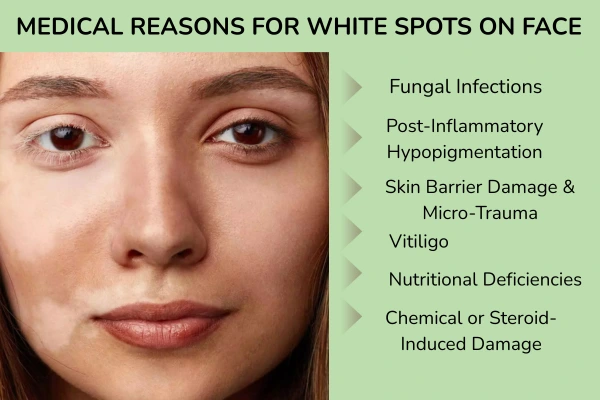
Understanding the reason for the white spots on the face is critical for choosing the correct white spots face treatment. These are the commonly recognised medical reasons behind the condition:
Fungal Infections: Superficial fungal infections caused by Malassezia yeast can lead to white or light-colored patches. These white spots on face often become more noticeable after sun exposure and may show fine scaling.
Post-Inflammatory Hypopigmentation: After acne, eczema, burns, or cosmetic procedures, the skin may temporarily lose pigment. These white marks on face usually appear after healing and gradually improve with proper dermatological care.
Skin Barrier Damage & Micro-Trauma: Tiny white raised spots are often misinterpreted as pigmentation. When the skin barrier is disrupted due to trauma, procedures, or friction, milia may form as keratin becomes trapped under the skin.
Vitiligo: Vitiligo is an autoimmune condition where melanocytes are destroyed by the immune system. It presents as sharply defined white spots on face and other body areas. Early diagnosis significantly improves treatment outcomes and long-term control.
Nutritional Deficiencies: Deficiencies of Vitamin B12, Vitamin D, and calcium can sometimes contribute to hypopigmented patches. In such cases, white spots treatment must address both skin health and internal deficiencies.
Chemical or Steroid-Induced Damage: It is another reason for white spots on face. The prolonged use of topical steroids or harsh cosmetic products can suppress melanin production, leading to persistent white marks on the face.
Each of these conditions requires a different white spots treatment strategy, which is why self-treatment without diagnosis often fails.
Types of White Spots on Face: Dermatological Classification
Dermatologists further classify these spots on face based on clinical behavior:
Temporary white spots—often due to inflammation, dryness, or fungal infection
Progressive white spots—common in vitiligo or autoimmune conditions
Stable white marks on face—long-standing patches that do not spread but require pigment stimulation
This classification directly influences the choice of white spots on face treatment and expected outcomes.
How to Get Rid of White Spots on the Face: A Dermatologist’s Approach
If you are searching for how to get rid of white spots on the face permanently, the answer lies in personalized diagnosis followed by targeted treatment. There is no single cream that treats all white spots.
At a dermatology clinic, evaluation may include:
Detailed clinical examination
Dermoscopy for pigment analysis
Blood investigations when nutritional or autoimmune causes are suspected
Once the exact cause is confirmed, a customized treatment is planned for safe and effective results.
Modern dermatology offers multiple safe and effective white spots face treatment options. The choice of treatment depends on the cause, depth, stability, and skin type and is always individualized.
1. Medical Topical Therapy
Prescription-based creams containing antifungal agents, mild corticosteroids, or immunomodulators are used to control inflammation, treat infections, and stimulate pigment recovery in early or mild cases of white spots on the face.
2. Oral Medications
In selected cases, oral antifungals, vitamin supplements, or immune-modulating medicines are prescribed to support internal healing and enhance the effectiveness of topical white spots treatment.
3. Laser Treatments
Advanced laser treatments help activate dormant melanocytes and improve pigment uniformity. Laser therapy is commonly used for stable white marks on face and is performed under strict dermatologist supervision to ensure safety and precision.
4.Radiofrequency (RF) Ablation
RF ablation is an effective treatment option for specific conditions like milia or localized superficial white lesions that do not respond to creams. Controlled radiofrequency energy is used to safely remove the lesion with minimal damage to surrounding skin. RF ablation allows faster healing and reduces recurrence when performed by an experienced dermatologist.
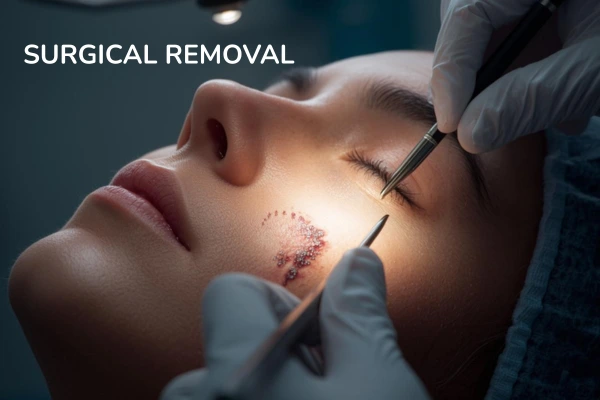
5. Surgical Removal
Surgical removal may be advised in rare, well-defined cases such as persistent milia, certain nevi, or stable non-progressive lesions. These procedures are minor, performed under local anesthesia, and selected only when conservative white spots on face treatment options are ineffective.
Skin Barrier Repair Protocols
For patients with dryness-related white marks on the face, restoring the skin barrier using medical-grade moisturizers is essential for long-term improvement.
Why Treatment Selection Matters
Not every white spot on face requires advanced procedures. Inappropriate treatment can worsen pigmentation or delay results. That is why dermatologist-led evaluation is critical before choosing RF ablation, laser therapy, or surgical options.
Why Home Remedies Often Fail for White Spots Treatment?
Many patients try home remedies expecting quick results. However, without understanding the exact reason for the white spots on the face, these methods usually provide only temporary improvement, or none at all. In some cases, they worsen irritation and make white spots more visible.
Dermatologist-guided white spots treatment ensures accuracy, safety, and visible improvement.
When Should You See a Dermatologist?
You should consult a dermatologist if:
The spots are increasing in size or number.
Patches have sharp or expanding borders
There is associated itching or scaling.
Home treatments are ineffective.
There is a family history of vitiligo.
Early intervention always leads to better outcomes.
Expert Dermatologist Solutions at Evenly Clinic
At Evenly Clinic, white spots on face treatment is approached with precision and care. Each patient undergoes a detailed skin evaluation followed by a customized treatment plan. Our dermatologist-led protocols focus on identifying the root cause rather than masking the symptoms.
With advanced diagnostic tools, evidence-based treatments, and continuous monitoring, we ensure that patients receive safe, effective, and result-oriented white spots face treatment.
Can White Spots on the Face Be Treated Permanently?
Many types of spots on face can be significantly improved or even reversed when treated early. While conditions like vitiligo require long-term management, medical science today offers excellent control and cosmetic improvement options.
Consistency, correct diagnosis, and expert supervision are the keys to success.
These spots should never be ignored or self-treated blindly. Whether they appear as subtle white marks on face or progressive pigment loss, dermatological science today offers reliable, safe, and effective solutions.
If you are noticing new or unexplained spots on your face, consulting an experienced dermatologist like Evenly Skin and Hair Clinic can make all the difference, not just for your skin, but for your confidence as well.
BeforeAfter
Evenly Skin and Hair Clinic – HSR Layout
Third Floor, 815, 27th Main Rd, above Bluestone, 1st Sector, HSR Layout, Bengaluru, Karnataka 560102
Evenly Skin and Hair Clinic – Jayanagar
35, Ground Floor, Vinyas Arcade, 11th Main Rd, Vishya Bank Colony, 5th Block, Jayanagar, Bengaluru, Karnataka 560041
They are caused by reduced or absent melanin production in certain skin areas. Common reasons include fungal infections, post-inflammatory hypopigmentation, vitiligo, skin barrier damage, nutritional deficiencies, and prolonged use of topical steroids or harsh cosmetics.
Are white marks on face permanent?
Not always. Many white marks on face are temporary and improve with treatment. Conditions like vitiligo may need long-term management, especially if diagnosed late.
Can white spots on face spread?
Yes, some white marks on face can spread, especially fungal infections or vitiligo. Early treatment helps prevent progression.
Can vitamin deficiency cause white spots on the face?
Yes. Deficiencies in vitamin B12, vitamin D, and calcium can sometimes lead to white marks on the face. Treating the deficiency is an important part of white spots face treatment.
Are white spots on face a sign of vitiligo?
Not always. While vitiligo causes white spots on the face, similar patches can also occur due to fungal infections or post-inflammatory hypopigmentation. A dermatologist’s diagnosis is essential.
Are white marks on face related to sun exposure?
Sun exposure does not cause these marks/spots on face directly, but it can make existing white marks on face more noticeable due to contrast with surrounding skin.
Can diet help in white spots treatment?
A balanced diet supports skin health, but diet alone cannot treat. Nutritional correction is used alongside medical treatment when deficiencies are present.
We hope this information is helpful. If you have any skin and hair-related questions or would like to discuss personalized solutions, please reach out to us at 7337899030. Our team of specialists is committed to delivering personalized care tailored to your specific needs. Take the first step towards a healthier, more confident you by scheduling a consultation with us today. Your journey to vibrant skin and stronger hair begins here.
Post Views:800
Book an Appointment
Start your journey to healthy skin and hair today.






Leave a Comment