Have you ever changed your outfit at the last minute because of dark spots on your legs and feet? Or uneven pigmentation around your knees. Hyperpigmentation on legs is far more common than most people realize. In fact, both men and women frequently develop dark spots on legs and feet due to shaving, insect bites, sun exposure, friction, infections, or even circulation issues. Yet many patients silently try home remedies, scrubs, and random creams without understanding the real cause behind their pigmentation on legs and feet.
Not all pigmentation is the same, and not every treatment works. Some forms of hyperpigmentation on legs require topical treatment; others respond better to chemical peels. But, when pigmentation becomes deep, persistent, or resistant, advanced laser therapy may be the most effective solution to remove hyperpigmentation on legs safely and scientifically.
But does laser therapy actually work? Is it safe for your skin, and can pigmentation return after the treatment?
In this comprehensive blog, we will explain everything you need to know about hyperpigmentation on legs, its causes, modern treatment options, and whether laser therapy truly delivers long-term results. If you are tired of covering up and ready to understand your skin properly, keep reading.
Hyperpigmentation on legs refers to localized or diffuse darkening of the skin caused by excess melanin production or pigment deposition in deeper skin layers.
Compared to facial pigmentation, hyperpigmentation on legs treatment can be more complex because:
The skin is thicker.
Circulation is slower
Friction and shaving are common triggers.
Post-inflammatory pigmentation is frequent.
Before knowing the treatments that work, we need to understand the causes of them.
Why Do Dark Spots on Legs and Feet Appear?
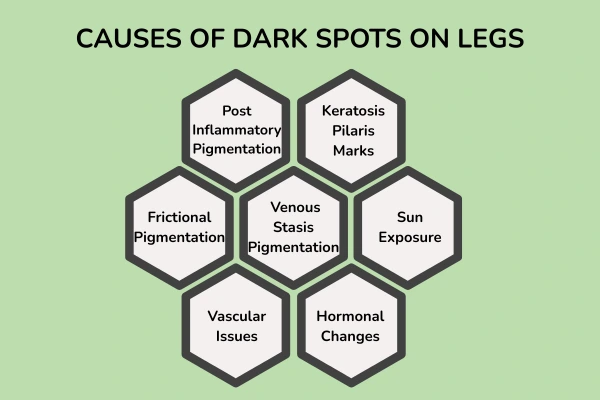
The below are some of the common causes of dark spots on legs and feet.
Post-Inflammatory Hyperpigmentation (PIH): This is the most common cause of hyperpigmentation on legs. It occurs due to insect bites, folliculitis, shaving cuts, wax burns, and allergic rashes. When the inflammation heals, the melanin gets deposited in the epidermis or dermis, leading to persistent dark spots on legs and feet.
Frictional Pigmentation: Constant rubbing between thighs or tight clothing can cause pigmentation on legs and feet over time.
Venous Stasis Pigmentation: Poor circulation can cause brownish patches near the ankles. In such cases hyperpigmentation on legs must address the vascular issue first.
Keratosis Pilaris Marks: Small bumps that heal with pigmentation.
Sun Exposure: Even the face and legs get tanned. Unexposure stimulates melanin production and worsens hyperpigmentation on legs.
Can Topical Creams Remove Hyperpigmentation on Legs?
Topical treatments may include:
Hydroquinone
Azelaic acid
Kojic acid
Retinoids
Vitamin C
However, creams only work effectively for superficial epidermal pigmentation.
If pigment lies deeper, creams won’t work effectively and may need laser technology to address hyperpigmentation on legs.
Does Laser Therapy Really Work for Hyperpigmentation on Legs?
Laser treatment works by a principle called “selective photothermolysis.” The laser energy targets melanin pigments, breaks them into microscopic particles, and the body clears them naturally via lymphatics.
When selected appropriately, lasers can break down stubborn pigment, improve skin tone uniformly, stimulate collagen remodeling, and reduce long-standing dark spots on legs and feet.
Yes—laser therapy can effectively remove hyperpigmentation on legs, but success depends on the following:
Type of laser used
Depth of pigment
Skin type
Post-treatment care
Underlying cause
Which Laser Is Best for Hyperpigmentation on Legs?
Different types of lasers are used depending on pigment depth.
Professional expertise dramatically increases the chances to remove hyperpigmentation on legs safely.
Is Laser Worth It for Hyperpigmentation on Legs?
If you have tried topical medications with no improvement and want visible long-term improvement. Then laser therapy can be highly effective for hyperpigmentation on legs, provided it is customized to your skin type and cause.
Remember: Pigmentation is treatable. You don’t have to live with it.
However, do not chase random treatments. Seek a proper diagnosis. Because the right leg hyperpigmentation treatment makes all the difference.
Ready to Remove Hyperpigmentation on Legs Safely?
If you are struggling with pigmentation on legs and feet, consult a qualified dermatologist for evaluation.
At Evenly Skin & Hair Clinic, we design personalized treatment protocols to safely and effectively remove hyperpigmentation on legs using advanced, evidence-based laser technology.
Evenly Skin and Hair Clinic – HSR Layout
Third Floor, 815, 27th Main Rd, above Bluestone, 1st Sector, HSR Layout, Bengaluru, Karnataka 560102
Evenly Skin and Hair Clinic – Jayanagar
35, Ground Floor, Vinyas Arcade, 11th Main Rd, Vishya Bank Colony, 5th Block, Jayanagar, Bengaluru, Karnataka 560041
No, hyperpigmentation on legs is not permanent in most cases. However, the duration depends on the depth of pigment. Superficial epidermal pigmentation may fade within months with appropriate treatment, while deeper dermal pigmentation can persist longer.
How many laser sessions are required for hyperpigmentation on legs treatment?
Most patients require 4 to 8 sessions spaced 3–4 weeks apart. Mild pigmentation on legs and feet may improve in fewer sessions, whereas deeper or resistant pigmentation may require additional sittings.
Can chemical peels treat hyperpigmentation on legs?
Yes, chemical peels can treat superficial hyperpigmentation on legs. They help exfoliate pigmented skin cells and promote regeneration. However, deeper pigmentation often responds better to laser therapy or combination treatments.
Can diabetes cause dark spots on legs and feet?
Yes. Uncontrolled diabetes can contribute to skin darkening, infections, and delayed healing, leading to dark spots on legs and feet. Proper medical management of the underlying condition is essential alongside dermatological treatment.
Is hyperpigmentation on legs a sign of an underlying medical condition?
Sometimes. While most pigmentation on legs and feet results from inflammation or sun exposure, certain conditions like venous insufficiency, diabetes, hormonal imbalance, or chronic dermatitis can contribute.
We hope this information is helpful. If you have any skin and hair-related questions or would like to discuss personalized solutions, please reach out to us at 7337899030. Our team of specialists is committed to delivering personalized care tailored to your specific needs. Take the first step towards a healthier, more confident you by scheduling a consultation with us today. Your journey to vibrant skin and stronger hair begins here.
Post Views:960
Book an Appointment
Start your journey to healthy skin and hair today.












Leave a Comment