Are stitch marks making you feel self‑conscious every time you look in the mirror or step out in public? While stitches are medically essential for proper wound closure, the marks they sometimes leave behind can feel like an unfair reminder of a phase you have already overcome. This concern becomes even more sensitive when these marks appear on visible areas such as the face, lips, or other exposed body parts, where even a small scar can alter the facial harmony and confidence.
So, continue reading to understand how to remove stitch marks safely and effectively with advanced dermatological treatments, especially in sensitive areas like the face and lips.
What are stitch marks, and why do they form after surgery?
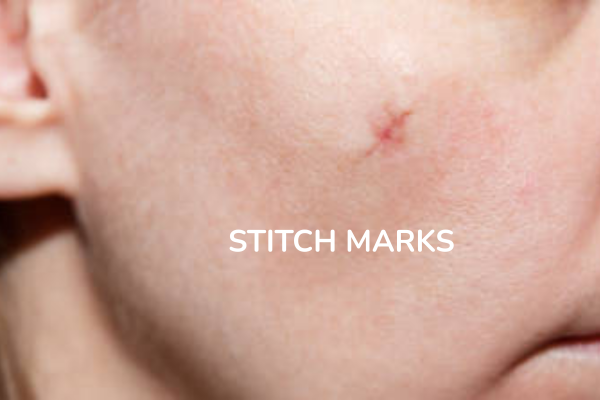
These marks are post‑surgical scars that develop along the path where sutures were placed to close a wound. During healing, the skin produces collagen to repair the damaged tissue. However, when collagen deposition is excessive, uneven, or disrupted, visible stitch marks remain. Also, it is important to understand that the marks are not necessarily a sign of poor surgery. Several factors influence how the marks appear, including
Depth and length of the surgical incision
Type of sutures used (absorbable vs. non-absorbable)
Duration for which stitches remain in place
Infection or delayed wound healing
Skin type, especially melanin-rich skin
Genetic tendency to form scars
This is why stitch marks on the face or lips tend to look more prominent—the skin in these areas is thinner and more delicate.
Why Stitch Marks Look Different on Different People
There is no single appearance of these scars. Dermatologically, they vary based on wound depth, healing time, and the location.
Fine Linear Stitch Marks: These appear as thin lines following the incision path. They often fade but may remain visible under certain lighting. These are the most common marks after surgery.
Hypertrophic Stitch Marks: These are raised stitch marks that stay within the wound boundary and feel firm. They occur due to excess collagen production during healing. Early dermatological intervention can help flatten them effectively.
Atrophic Stitch Marks: Depressed or sunken marks caused by collagen loss. They are commonly seen on the face and require collagen-stimulating treatments.
Pigmented/Darkened Marks: These scars appear darker or uneven in color and often require specialized dermatological treatment to prevent further pigmentation.
Stitch Marks on Face and Lip: Can They Be Removed?
Stitch marks on the face or lips are emotionally more distressing because they are constantly visible and directly affect facial aesthetics. Facial scars heal differently due to higher blood supply, frequent muscle movement, and thinner skin layers.
Areas such as the cheeks, lips, jawline, nose, eyelids, and forehead require precise and customized treatment planning by a dermatologist.
When Is the Right Time to Start ScarsRemoval?
Timing plays a critical role in how to remove stitch marks after surgery effectively.
0–3 months: Focus on wound care and sun protection
3–6 months: Ideal time for non-invasive stitch scars removal treatments
6+ months: Advanced energy-based procedures may be required.
Early intervention almost always leads to better and faster outcomes.
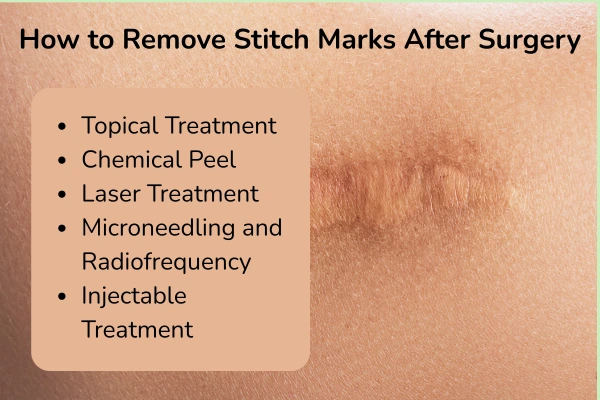
How to Remove Stitch Marks After Surgery: Advanced Dermatology Treatments
There is no single stitch marks removal treatment. Dermatologists use customized treatment combinations based on the scar type and location.
Chemical Peels
Chemical peels are widely used to improve superficial marks and post-surgical pigmentation. In this procedure, controlled chemical agents are applied to exfoliate damaged outer skin layers.
As the treated skin sheds gradually, new and healthier skin cells replace it. For stitch marks on the face, dermatologists carefully select peel strength to avoid irritation while improving tone and texture.
Chemical peels are most effective for flat scars and pigmentation following surgery. Multiple sessions may be required depending on scar depth and skin sensitivity.
Laser treatment is one of the most advanced and effective options to reduce scars after surgery. Fractional lasers work by delivering focused energy into scar tissue, breaking down abnormal collagen while stimulating new collagen formation.
Laser removal is especially beneficial for stitch marks on the face, as it improves both texture and color without damaging surrounding healthy skin. Results improve gradually over multiple sessions as skin regeneration continues.
Microneedling is a collagen-induction therapy that treats the scars or marks by triggering the skin’s natural healing response. Using a device equipped with fine medical-grade needles, controlled micro-injuries are created in the scar tissue.
These microchannels stimulate new collagen and elastin production, helping depressed or uneven stitch marks become smoother over time. Microneedling is particularly effective for atrophic scars after surgery and is often combined with radiofrequency for enhanced results.
Raised or thick marks, also known as hypertrophic scars, may respond well to intralesional injections. These injections help soften excess scar tissue, flatten the raised area, and reduce redness or discomfort.
Injectable therapy is performed at controlled intervals and is often combined with other modalities for optimal stitch marks removal outcomes.
Common Mistakes That Worsen Marks
Delaying treatment
Using harsh home remedies
Ignoring sun protection
Self-treating stitch marks on the face without medical guidance
Avoiding these mistakes significantly improves the removal outcomes.
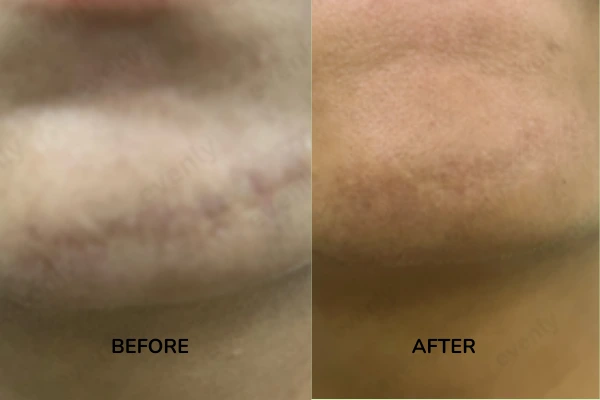
What results can you expect from Scars removal Treatment?
With the right treatment plan:
It gradually soften and flatten
Skin tone becomes more even
Texture improves significantly
These marks can affect how you feel about your recovery, but they do not have to be permanent. With today’s advanced dermatological treatments, stitch marks removal is safer, more effective, and more predictable than ever before.
If you are searching for how to remove stitch marks after surgery, consult a qualified dermatologist at Evenly Skin and Hair Clinic. We focus on evidence-based treatments that prioritize safety, aesthetics, and long-term results.
Your healing journey doesn’t end with surgery—it continues with the right skincare decisions.
Evenly Skin and Hair Clinic – HSR Layout
Third Floor, 815, 27th Main Rd, above Bluestone, 1st Sector, HSR Layout, Bengaluru, Karnataka 560102
Evenly Skin and Hair Clinic – Jayanagar
35, Ground Floor, Vinyas Arcade, 11th Main Rd, Vishya Bank Colony, 5th Block, Jayanagar, Bengaluru, Karnataka 560041
From a medical perspective, complete removal of marks or scars is rare. However, with advanced scar removal treatments such as laser therapy, microneedling, and injectables, it can be significantly reduced and made far less noticeable. The goal of treatment is improvement in texture, color, and visibility rather than total erase.
How many sessions are required for stitch marks removal?
The number of sessions depends on the type and severity . Superficial marks may require fewer sessions, while deeper or raised scars may need multiple treatments over several months. Your dermatologist will outline a personalized treatment plan.
Can stitch marks on lips be treated?
Yes, but they require specialized care due to delicate skin. Only selected treatments under strict medical supervision are recommended.
Will stitch marks become darker after treatment?
When treatments are performed correctly, the risk of darkening is minimal. Choosing an experienced dermatologist is essential.
Are creams alone enough for stitch marks removal?
Medical creams can support healing and improve mild marks, but they are usually not sufficient for visible or deep scars.
Is laser treatment safe for stitch marks removal?
Yes, laser treatment is safe and effective when performed by trained professionals. Fractional laser technology is commonly used to treat these marks by remodeling scar tissue and stimulating new collagen formation.
Can stitch marks return after treatment?
Once stitch marks improve, they usually do not return. Adhering to post-treatment care guidelines is crucial for maintaining long-lasting results.
We hope this information is helpful. If you have any skin and hair-related questions or would like to discuss personalized solutions, please reach out to us at 7337899030. Our team of specialists is committed to delivering personalized care tailored to your specific needs. Take the first step towards a healthier, more confident you by scheduling a consultation with us today. Your journey to vibrant skin and stronger hair begins here.
Post Views:1,379
Book an Appointment
Start your journey to healthy skin and hair today.







Leave a Comment